Monday, March 12, 2012

#20- Little Lost Rabbit


Little Lost Rabbit
Written and Illustrated by: Harry Horse
Peachtree Publishers
2004
30 pages
Fantasy
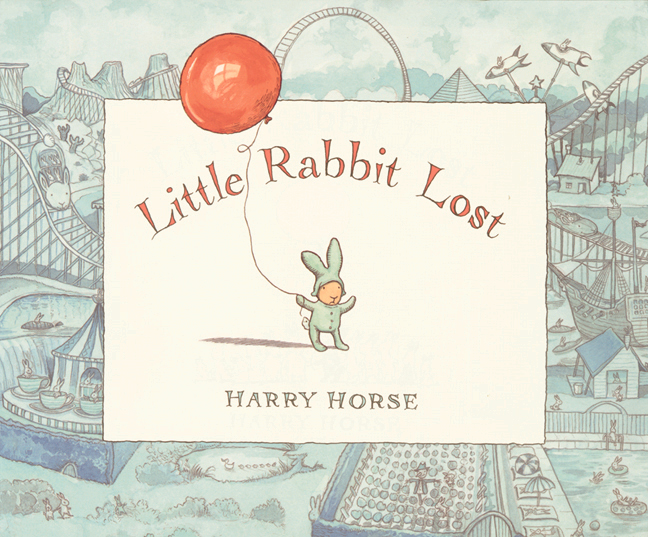
This book is about a rabbit on his birthday. He gets a red balloon for his birthday and carries it with him everywhere. Since it was his birthday he felt like he was a “big boy” now. For his birthday he wanted to go the Rabbit World. On the way there he was so excited to be going to the theme park. After a while he realized he could not do a lot of the things because he was too small. He was upset because he had to watch everyone else ride while he stayed with his mom. Little rabbit wondered off and got lost. He was scared. Finally, his parents found him by his big red balloon. The family was happy and they had cake for his birthday.
Harry Horse used pen and ink and watercolor to create these illustrations. The text is informally placed around the pictures. The illustrations are all dull colors except for the red balloon that Little Rabbit carries. This helps the reader locate the Little Rabbit throughout the book and is a focal point of the book. The line of the book is horizontal. When Little Rabbit is scared and lost, the illustrator uses gloomy colors like gray, brown and blue. When the parents find Little Rabbit the pages become brighter. Cross-hatching is used for the shadow effect in this book.
This book is appropriate for preschoolers through third grade. Little Rabbit Lost could inspire many lessons to be taught in the classroom. You could teach students about rabbits. Another way this book could be used is to talk about lost children and how to stay safe. I think this would be a great book to read before you go on a field trip to keep students aware of the importance of staying with the group. Birthdays could also be taught from Little Rabbit Lost  by teaching the different months of the year.  This book has received the award of Scottish Arts Council Children's Book Award in 2003.

#19- If You Give a Pig a Party


If You Give a Pig a Party
Written by: Laura Numeroff
Illustrated by: Felicia Bond
Harper Collins
2005
27 pages
Fantasy

In this book there is a pig that has a party. The pig asks for some balloons because she wants to decorate. When all the decorations are hung she puts on her dress. Then she calls to invite her friends to the party but she cannot get them so she goes out to look. While she is out she sees a street fair and decides to go. The pig loves the bumper cars so she goes there and finds all her friends. After that they all have ice cream and get messy so they need to change clothes. Once they get home they eat dinner and have a sleepover.
The illustrations by Felicia Bonds are cartoon-like. The line of the book is diagonal. It looks like the medium that Bond uses is water color and color pencils to create her illustrations. The colors used in this book are bright colors that go along with the party theme of the book. The text is informally placed around the pictures.
This book would be appropriate for students ages three to seven. This book would be ideal to use if you were teaching your students sequencing. In this book every event leads to another. This would be simple for the students to comprehend in kindergarten. You could also teach about pigs. This book doesn’t have what pigs usually do because it is a fantasy. It would be a way to get students curious about pigs. Another way this book could be used is by teaching students about fiction and non-fiction. This book has received the award for the 2006 Quill Award. It is easy to see by her work that she is a talented author.  

#18- All Aboard the Dinotrain


All Aboard the Dinotrain
Written by: Deb Lund
Illustrated by: Howard Fine
Harcourt Inc.
2006
32 pages
Fantasy

I chose this book because of the illustrations. This book has big vibrant pictures that draw a reader in a reader. All Aboard the Dinotrain is about dinosaurs that are traveling on a train. The train is moving slowly so they “dinopush” the carts up the hill, ride up steep hills, duck to miss the tunnels, and crash into a lake where the track ends. The dinosaurs end up getting back home by all of them piling up on a handcar. The dinosaurs make it home and they say they will never ride another train but maybe a plane. Their family was happy they were back.
Howard Fine completed the illustrations in gouache and watercolors. The text is informal text placement around the illustrations. The flyleaf and the end paper are illustrated with pictures of the dinosaurs with their job titles on the train and the type of dinosaur they are. This book is very large and the line is horizontal. This is fitting because the dinosaurs are drawn to scale along with the other objects included in the illustrations. The illustrators use a lot of intense vibrant colors. The scenery is illustrated in a pale or more saturated look that brings attention to the bold colored train and the dinosaurs. The illustrations of the dinosaurs are created with texture. It looks like you can feel their rough skin. The composition or the arrangement of the visual elements seems to be arranged around the train.
This book is appropriate for kindergarten students and up. This book would appeal most to younger boy students. In the science classroom, this would be a great book to introduce dinosaurs especially using the fly leaf and the end paper that list the types of dinosaurs. This book would be useful when learning about railroads for a younger classroom and to teach the students all the different jobs on the train. This book would also be a great resource to show rhyming words. For character education you could teach the students about working together or never giving up. This book has received an award recently in 2012. This award is called the Bank Street College of Education Best Children's Book. I believe this book would be great to get students involved in your classroom lesson or just a great read. 

#17- Yummy Eight Favorite Fairy Tales


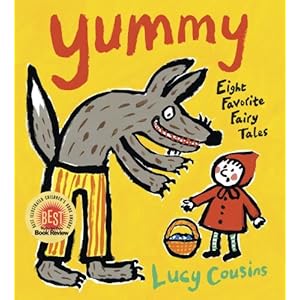
Yummy Eight Favorite Fairy Tales
Written and Illustrated by: Lucy Cousins
Candle Wick Press
2009
121 pages
Traditional Literature

I chose this book because it is a collection of traditional literature piece that remind me of my childhood. This book has eight fairy tales that are well known. They are Little Red Riding Hood, The Three Billy Goats, The Enormous Turnip, Henry Penny, Goldilocks and the Three Bears, The Little Red Hen, The Three Pigs, and The Musicians of Bremen. The book has a contents page and the pages are numbered so it is easy to find each story.
The illustrations of this book are my favorite part. Each page has bold bright colors and the pictures are rigid. The illustrations were done in gouache. The book is a large square book so the pictures are large and exciting to look at. The text is informally placed and very informally placed. The titles and main ideas from the pages are very informally placed while the main story line is informally placed around the illustrations.
This book is appropriate for students starting at age three and up to age eight. This book would be great to read as a bed time story and to use in your classroom. When using this book in your classroom you could teach children the traditional stories and how they are passed down. Each story teaches children a different lesson that would be great to use for character education. You could use the different stories to teach children about animals like wolves, pigs, hens and others. Lucy Cousins is most well known for her character Maisy. This character is loved by many young readers. Yummy Eight Favorite Fairy Tales  received the Best Illustrated Children's Book Award. Cousins has received other awards like the Bologna Ragzzi Non-fiction Prize 1997 for Maisy’s House and the National Art Illustration Award in 1997 for the book Zaza’s Baby Brother. Lucy Cousins is a very talented author and illustrator.

#16- The Penguin and the Pea


The Penguin and the Pea
Retold and Illustrated by: Janet Perlman
Scholastics
2004
27 pages
Traditional Literature

This book is about a penguin that gets caught in a storm and runs to a castle for shelter. The penguin did not know it but at the same time the King and Queen were looking for a princess for their son. The parents were not convinced that she was a queen because she looked terrible after being out in the storm. The parents decided to test her by putting a cabbage under her bed. She saw the bed and said it looked lumpy but still tried to sleep on the bed. She did not sleep at all. The mom decided she needed a harder test so she put a pea under nineteen mattresses and twenty heavy quilts. The next morning she was on the floor because she could not sleep on the bed. The parents and the son were so happy because they knew that she was royalty. The penguins lived happily ever after and the pea is on display in the Royal Penguin Museum.
Perlman's artwork was drawn in ink on paper then colored in Photoshop. The book's text is formally placed and most formally placed in the book. The book has the text across from the framed pictures and under the framed pictures. Spot art is also used below the text. The line of the book is horizontal. The colors that are used in the book are bright rich looking colors. At night when the penguin is sleeping darker colors are used to represent night.
This book is appropriate for children who are three years and up. As a teacher, you could you this book in your classroom in my different ways. You could link this story to the Princess and the Pea. While doing this you could show your students how they can model their story off a traditional story they might know. You could turn this into a writing assignment. It would be entertaining to hear the spin-off stories the students come up with based around traditional stories. You could also use this book for character education to encourage students to tell the truth. Another way this book could be used is to teach students about royalty or if you have a theme on penguins. Janet Perlman is a director and writer of short films as well as an author and illustrator of children’s books. She has received many awards for her short films. Here is an example of one of her award-winning short films. This one is called The Tender Tale of Cinderella.

Sunday, March 11, 2012

#15- Goldie Locks Has Chicken Pox


Goldie Locks Has Chicken Pox
Written by: Erin Dealey
Illustrated by: Hanako Wakiyama
Scholastics Inc.
2002
34 pages
Traditional Literature

            I chose this book because it is a different version of the story I grew up hearing. It includes characters from stories like Little Red Riding Hood, Bo Peep, and others. The main character  had a brother that was a pest. He would give her a hard time about having the chicken pox and pick on her. He teased the the sister until he got the chicken pox. 
Hanako Wakiyama rendered the illustrations in oil paint. The colors in this book are red, blue, yellow, and brown. The colors are repetitive. The text is placed informally on the page around the pictures. The lines in this book are solid and negative space is used. The shapes are very defiant and geometric shaped. The bed and the curvy couch are examples of shape. The texture is not too evident in the book so most all the objects look solid. The composition of this book is balanced.
This book is appropriate for children starting at age three and up. I enjoyed this book at the age of twenty because it is a mix of the childhood stories. I would recommend using this to educate young children about chicken pox. I think it would be a great idea to read if one of the students had the chicken pox so that other students will not downgrade that student. This book would help them understand the chicken pox so the students would not feel like an outcast..You could also use this book for character education by using the brother as an example. Goldie Locks Has Chicken Pox was Erin Dealey first picture book. She is a motivational speaker, actor and K-12 teacher. Her book was Children’s Book of the Month Club featured in Scholastics and is available in Braille.   

#14- Recess, Rhyme, and Reason: A collection of Poems About Schools


Recess, Rhyme, and Reason: A collection of Poems About Schools
Compiled and Annotated by: Patricia M. Stockland
Illustrated by: Sara Rojo Perez
Compass Point Books
2004
Poetry


I chose this book because I thought it would be easy for every student to relate to it. This book is complied of numerous poems about school. It has topics like the school bus, playground, the first day of school, homework, math, and friends. It is focused around identifying the different elements in poetry like personification, concrete, compare and contrast, rhyme, rhythm, and so much more. The book has a “toolbox tip” on every page. It also has a glossary that tells you what each poetry word means.
The illustrations in this book look like they were drawn in water color and color pencil. The text is informally placed on the page around the pictures. The pictures are cartoon-like and are very simple. This book has a lot of negative space used on every page. The colors are pale and texture in the illustrations is not present in this book.
This book is appropriate for students in the third grade through the sixth grade. This is the ideal book to use when you are teaching your students poetry. It would be wonderful to use because each poem introduces another element of poetry. This book would also be great to use on the first day of school or about homework because the poems are specific to a certain topic. This book has not received any awards on its own but the authors have received several awards for their work with poetry individually. 

#13- The Night Before The Night Before Chirstmas


The Night Before The Night Before Christmas
Written by: Natasha Wing
Illustrated by: Mike Lester
First Scholastics printing
2007
27 pages
Poetry

I chose this book because of the title. I thought it would be interesting to read a take off of the regular version of The Night Before Christmas. In this book, it seems like everything is going wrong before Christmas. The mom is sick, she burns the cookies, the Christmas tree lost half of its needles, their stockings have holes in them, and terrible last minute shopping. To top it all off, when they get home the cat has destroyed the house. The family ends up having a great Christmas because they have all they need and that is love.
The illustrations in this book look like they are done with color pencil and watercolor. The pictures are cartoon-like and are bright with color. Negative space is used in some of the pictures only showing the important things for that page. The text is informally placed on the page. The line of this book is jagged to illustrate all the commotion at Christmas time. A lot of cool colors are used since the setting is during Christmas.
This book is appropriate for preschool students and up. At the age of 20, I enjoyed this book. I would recommend using this book when reviewing holidays. It would also be a great book to use for character education. Even though the characters have a bad Christmas holiday, they still are happy because they have each other and love. Natasha Wing has not received any awards for this book but has receive awards for some of her other books like the USA Today Best Seller for The Night Before Kindergarten and her book Jalapenos Bagels received the Please Touch Museum (Philadelphia) Book Award. The Night Before the Night Before Christmas is a great book to put a different spin on the story we all know so well. 

#12- Wings on the Wind


Wings on the Wind
Collected and Illustrated by: Kate Kiesler
Clarion Books
2002
40 pages
Poetry

I chose this book because all the poems are about birds. Another reason I liked this collection of poems is because of the pictures that illustrate the poems. The work in this book is collected from different authors on the topic of birds. Most of the poems are shorter than a page long. The poems are about different types of birds, where they live, the different seasons, the trees the birds land on, and feeding the birds.
Kate Kiesler used oil paint to create the illustrations. I noticed on the simple short poems the illustrator has the picture on the page across from the writing using the most formal text placement with spot art under the text. The poems that are longer are set up different. The write is placed around the illustration using the informal text placement. The poems that have a landscape behind them use a horizontal line. The colors that are in this collection of poetry are pale and less saturated. Cool and warm colors are used depending on the poem. The illustrator uses texture. It is easy to see the textures on the bird’s nest, the clouds, the bird’s feathers, and other places throughout the book.
This book is appropriate for children ages five and up. I would love to use this book in my classroom. You could use it to teach students about birds and about poetry. You could also teach about the different seasons and different types of birds. There are so many possibilities with this book because it is a collection of poetry. This book has not received any awards itself but the authors in this book have won numerous awards. 

#11- Roar of a Snore


#11-Roar of a Snore
Roar of a Snore
Written by: Marsha Diane Arnold
Illustrated by: Pierre Pratt
Dial Books for Young Readers
2006
32 pages
Poetry

This book is about the Huffle family. Jake could not sleep one night and it was all because of snoring. It was a loud snore. He woke up the dog, Mama Gwyn, Baby Sue, Papa Ben, and the twins but they could still hear the snore. They went to their barn to wake the animals and they could still hear the snore. The animals and the family looked around the barn and they found what was making the noise. It was a cute little kitten snoring. So all the animals and the family slept together in the barn and they made one loud snore.
Pierre Pratt used acrylic paints on paper to create the illustrations. Since the setting of the book is at night, the colors that are used are darker colors. These are colors like midnight blue, brown, dark red, and dark green. Cool colors and warm colors are used in the illustrations. The text is placed informally around the illustrations. The line of the book is very jagged in some pictures to show energy while they are looking for the sound. The pictures are horizontal when the people or animals are sleeping. Some negative space is use on a few pages when characters are walking to find the snoring sound. The shapes lack definition and some are rigid. The illustrations look like you could feel the texture because of the mixture of different colored paints. The paint is mixed with different colors to add texture and shadows to the illustrations.  
This book is appropriate for preschool and up. This book would be great to use to teach students about rhyming words. It would also be a good health lesson to teach students about snoring and sleeping. You could teach students about families using this book as well. The book Roar of a Snore has been chosen twice for Dolly Parton’s Imagination Library. Marsha Diane Arnold has received other awards for her other books like Ridgeway Award for Best First Book, State Children’s Choice Awards, IRA Distinguished Book, and Smithsonian Notable Book. Roar of a Snore is a great example of her award-winning work. 
This is a cute video of a son reading to his parents. He is about three or four years old.